
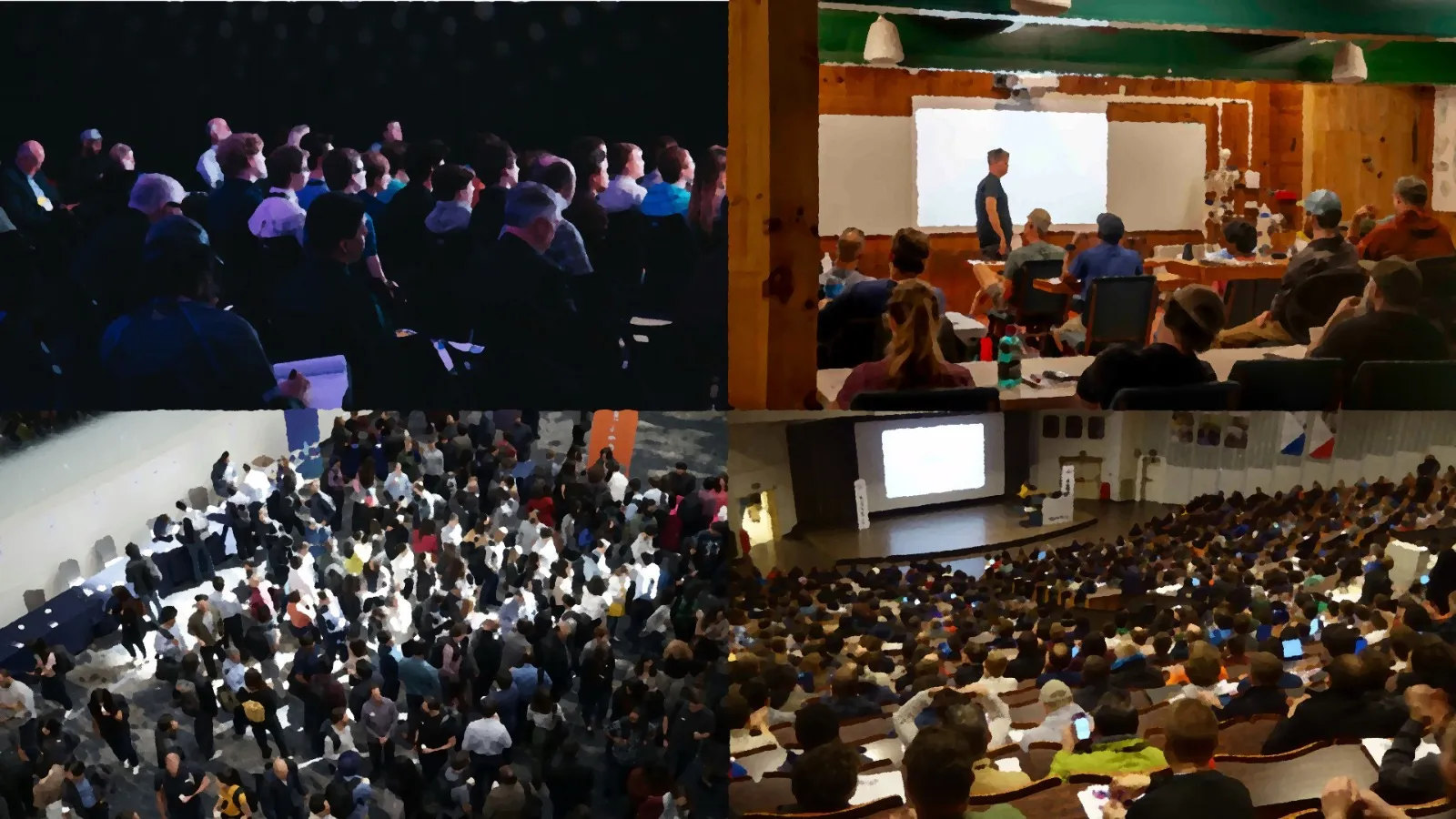
We are research software engineers (RSEs) which, as the name implies, means being involved in both research and software engineering. While this can sound overwhelming, it is also a great opportunity to interact with very different communities. So, what kind of conferences do we go to?
Below, we comment on the types of conferences we usually get involved in, and where you may find us. This might be interesting for people looking for new conferences, or trying to understand the mind of a research software engineer a bit better.
Domain-specific conferences
The first kind is perhaps the most common across research communities: the domain-specific conference. Here, “domain” refers to a specialized area of knowledge or scope of content. As a result, domain-specific conferences focus on specialized topics. They are also the venues where the latest and most exciting advances in those areas are often presented.
For example, Abel’s background is in applied mathematics, specifically numerical optimization, so conferences in that area interest him, and when he is working on projects that match that interest, he tries to join them. This year, he went to JuMP-dev + HiGHS Workshop 2026, presenting work related to the Tulipa Energy Model project. On the other hand, Angel’s background is in natural language processing, which is the application of computational methods to interact and communicate with computers using human languages (both understanding and generating written language). This year he presented a paper at TeachNLP Workshop - EACL 2026 conference, about teaching NLP fundamentals to researchers from other domains; and last year he also attended the DigitalHumanities 2025 Conference presenting work related to the Impact & Fiction project.
As research software engineers, we mostly present findings related to the software: for instance, computational results, or advances made possible by our involvement in the field. Sometimes we also help present purely academic findings, when we represent the project as a whole at the conference.
It is also common for us to go to mixed conferences, which are not purely about the domain but about its computational side and infrastructure. One example is the ODISSEI conference, coming up this November, which interests several of us in the Social Science & Humanities section. Another example is DUCOMS, which is also taking place at the end of November. DUCOMS brings together computational science professionals from all disciplines and career stages who apply their expertise to problems both in academia and industry. The conference illustrates how people working on problems that may seem very different on the surface can share core ideas to tackle complexity in their daily work.
Research Software and Open Science conferences
Another kind of conference we frequently get involved in focuses on research software and open science, such as RSECon, the International Research Software Conference (IRSC), or the Institute of Open Science Practices workshops.
These conferences overlap heavily with our other interests: making software more sustainable, making it an integral part of research, and making sure our contributions are valued not only as a tool but as part of the research itself. What also makes them special is the audience. Instead of being surrounded by people from closely related fields, we meet researchers, software engineers, librarians, data stewards, and policy makers who all care about how research software is built, shared, and credited. For us, this is a chance to compare notes with people who face the same everyday problems such as how to keep a project alive beyond its first grant, how to keep software maintainable once the original developers move on, or how to convince a research group that documentation and tests are worth the time.
Attending these conferences frequently involve looking at ourselves and at how we work. A talk about packaging a Python library or writing a good software management plan is relevant whether the code comes from astronomy, linguistics, or energy systems. Topics such as FAIR data, FAIR software, and software sustainability are very common. We often attend these conferences sharing our own experiences, whether it’s a lesson learned from a project, a workshop on good practices, or a discussion about how we apply the FAIR principles in practice, helping the community grow.
Technical conferences
On the other side, we have the more technical conferences. These focus on software first. They sometimes include applications from the academic world as well, but also they frequently feature purely software-centric presentations and industry applications.
Among those we attend at the eScience Center are conferences focused on high-performance computing (HPC) and GPUs, conferences specific to a programming language, such as PyCon or JuliaCon, and conferences mixing programming languages with other kinds of applications, such as PyData.
One such example is FOSDEM, a large technical conference held yearly in Brussels, now heading into its twenty-seventh edition. FOSDEM is a conference on free and open source software, and a breeding ground for open source enthusiasts. It includes tracks for research software and more specific ones, such as the Energy devroom, but it also offers networking opportunities and talks on purely computational subjects, such as Python, PostgreSQL, or Git itself.
These conferences are particularly useful because they keep RSEs up to date with technology improvements outside their usual community. For instance, at the last PyData (PyData Amsterdam 2026), a company presented how they use AI to identify bounding boxes in images, including how they gathered and labelled their data. The same kind of approach applies to some of our software; for example, in the Rags2Riches project we are also facing the problem of how to semi-automatically label our data at scale, so we benefit from that specific knowledge. It also helps that Abel (numerical optimization) and Angel (natural language processing) work on this project together and attend these conferences with very different eyes: the same talk can suggest a better labelling workflow to one and an optimization problem, such as deciding which data to label first, to the other. Combining both views is often how an idea from a conference turns into something concrete for one of our projects.
Beyond the Boundaries
In practice, these conferences don’t live in a vacuum. It is common to find topics that appear in all three kinds, or domain-specific topics showing up at a technical conference. FOSDEM is a good example, with its research software tracks and domain-specific ones like the Energy devroom Open source software.
The same goes for our projects: one of them can easily touch all three kinds of conference topics. We might present results at a domain-specific conference, discuss how to make the software sustainable at a research software event, and pick up a new technique at a technical one, as happened with Rags2Riches.
One of the things we look forward to most at conferences is meeting the people we have come to know over the years: people who helped us get where we are, people facing problems we have faced before, and people who will help us reach our next objectives, whether new positions, new ways to solve existing problems, or new collaborations. Many of these encounters happen outside the program, in a hallway or over lunch, and they are often where the best ideas are shared. In the end, what we are looking for is community.
Finally, another nice thing about these conferences is that they tend to be in very different parts of the world, allowing us to exchange ideas with people from different cultures and who have different problems in mind, which helps a lot to broaden our perspective.
If you are looking for conferences to attend, we hope this overview gives you a few ideas, and a better sense of how research software engineers think about the events they join. This November, you can find several of us at the ODISSEI conference and at DUCOMS, and we are always happy to chat.
AI Usage Disclaimer
AI was used for minor edits and cleanup in this post.
