Following the success of our previous in-person DReaMS meetups, it became clear that there was both enthusiasm and a genuine need for continued exchange between Research Software Management (RSM) professionals across the Dutch University Medical Centers (UMCs). Previous gatherings demonstrated the value of sharing experiences, discussing common challenges, and learning from each other’s approaches. As a result, we decided to continue the conversation and held our next community meeting on 3 June 2026, hosted by UMC Utrecht.
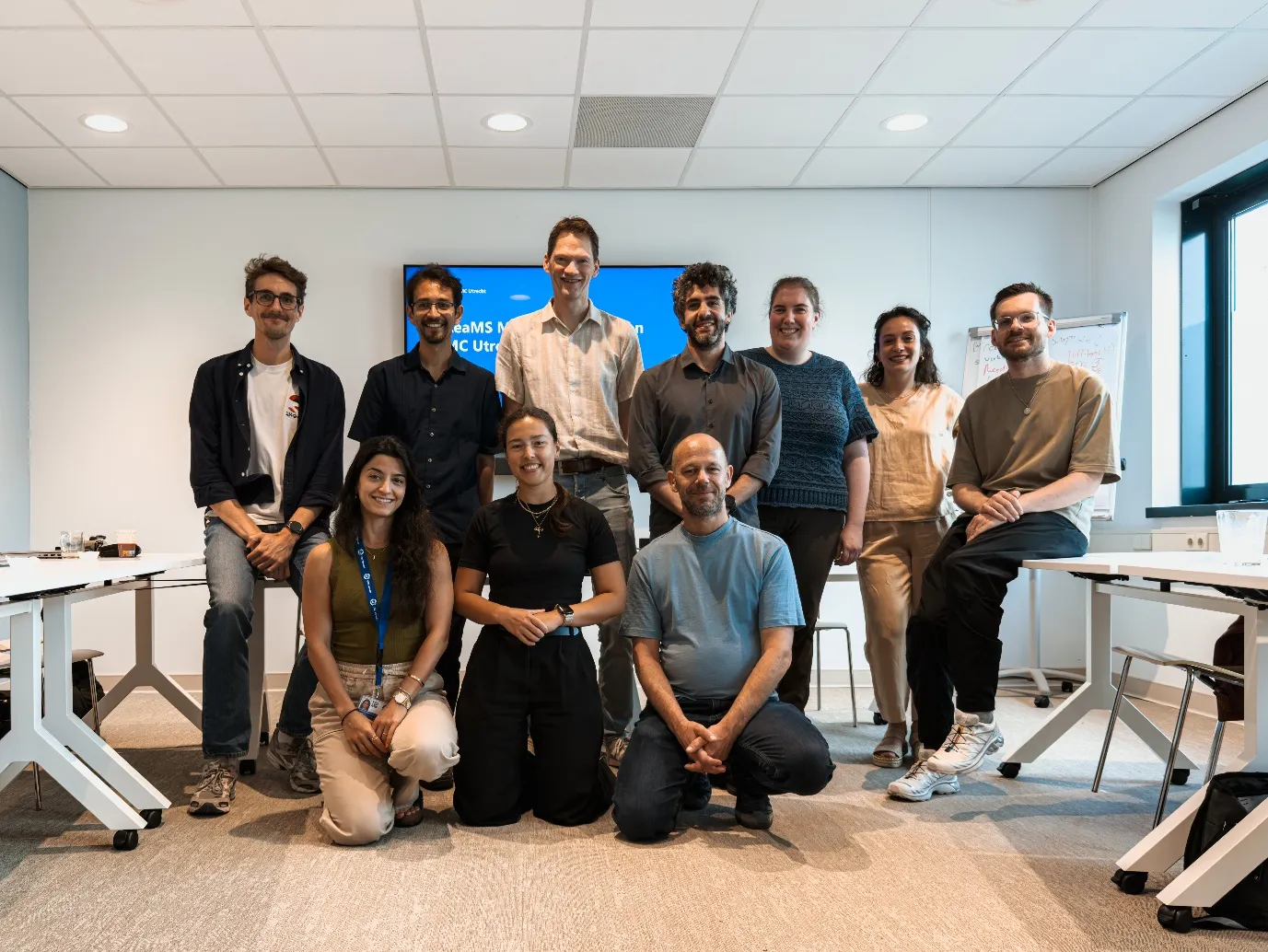 DReaMS meetup participants. Picture by Sara Mahdavi Hezavehi
The meeting brought together representatives from several Dutch UMCs, alongside colleagues from the Netherlands eScience Center and Health-RI. Similar to previous meetings, the atmosphere was open and collaborative, with participants eager to exchange ideas and identify opportunities for alignment across institutions.
Community Updates: Shared Challenges, Shared Opportunities
The first hour was dedicated to updates from participating organizations: UMCU, LUMC, AUMC, UMCG, and eScience Center, each sharing their current initiatives and priorities.
1. Software Management Plans continue to gain traction
Software Management Plans (SMPs) were a recurring topic across institutions. UMC Utrecht shared experiences with implementing SMPs through DMPonline, while LUMC reported ongoing work on SMP SMP templates in DS-Wizard, and AUMC on using the ELIXIR-STEERS SMP (Hancock et al., 2026), also using DS-Wizard, by building on work by Suchánek et al. (2023) . For a brief report on AUMC’s SMP activities, see van der Velde & Pronk (2026). An introduction on the development of SMP at LUMC is available at Introducing Software Management Plans at LUMC | Zenodo, and LUMC SMP knowledge model for DSW is available at LUMC-DCC/sciwiz-smp-km: Knowledge Model for creating Software Management Plans.
The discussion highlighted a shared interest in harmonizing approaches where possible, while recognizing that different use cases may require different implementations and tools.
2. Training and community building remain important priorities
Many institutions reported training-related initiatives, ranging from Git and version-control training to coding cafés, software curation courses, and support for research software engineering skills.
Participants exchanged experiences about engaging researchers and developers in these activities. While interest in training remains high, several attendees noted that building sustainable local communities and encouraging participation can still be challenging. This led to valuable discussions about audience needs, event formats, and ways to increase visibility within institutions.
3. Version control, licensing, and intellectual property
Another common theme was support for version control, software publication, licensing, and intellectual property considerations.
UMC Utrecht shared ongoing work around Git guidelines, licensing, copyright, and software publication practices. Similar topics emerged in updates from other institutions, confirming that legal and governance questions remain important parts of research software management support.
4. Update from eScience Center
eScience Center representative Carlos Martinez updated us on current and upcoming funding and talent development opportunities, including the Research Software Sustainability Fellows (RSSF 2026) call, as well as future initiatives such as a proposed Engineering Doctorate (EngD) programme focused on research software, data/AI, and scientific infrastructure. The update also highlighted developments around the Research Software Directory (RSD), with ongoing efforts to improve federation, integration, standardization, and training to strengthen interoperability between software registries and repositories and increase the visibility and sustainability of research software
Spotlight Discussion: SMPs
Following the coffee break, the group held a dedicated discussion on SMPs.
Participants exchanged experiences with different platforms and approaches, including DMPonline, DS-Wizard, and more traditional document-based workflows. The conversation focused not only on tooling but also on the broader question of what information SMPs should contain and how they can best support researchers throughout the software lifecycle.
Several interesting topics emerged:
-
Whether SMPs should be treated as living documents that evolve throughout a project’s lifetime.
-
Opportunities for machine actionable SMPs and integration with existing metadata and registry initiatives.
-
The balance between institutional requirements and community-wide harmonization.
The discussion also highlighted a shared interest in harmonizing approaches where possible, while recognizing that different use cases may require different implementations and tools.
Participants noted that each UMC approached the topic from a different perspective, including FAIR and Open Science, IT security, and regulatory compliance. Consequently, SMPs were often developed with different objectives in mind. For example, software developed as a medical device may require different considerations than software where security is the primary focus. Rather than enforcing a single template, there was interest in making a collection of SMP templates and examples available in a shared location, allowing researchers and support staff to select the most appropriate starting point for their specific context and requirements.
While no single solution fits every context, the discussion reinforced the value of continued collaboration and knowledge sharing between UMCs on this rapidly developing topic.
Looking Ahead: Where Does DReaMS Belong?
The second major discussion of the day was led by Thomas Pronk, who invited the community to reflect on the future positioning of DReaMS within the broader Dutch and international research software landscape.
Participants had to reflect on an important question: should the community remain fully independent, or would closer alignment with larger initiatives provide additional opportunities and long-term sustainability?
The discussion explored possible connections with organizations and networks such as ELIXIR-NL and NL-RSE, while emphasizing that DReaMS’ strength lies in its practical focus and active exchange between Dutch UMCs.
A clear consensus emerged: rather than focusing on formal organizational integration, participants preferred to align around shared goals, activities, and content. At the same time, there was broad recognition that some degree of organizational support can help ensure continuity, coordination, and community management in the longer term.
As a concrete next step, the group agreed to further explore collaboration opportunities with NL-RSE, potentially through jointly organized events and activities focused on research software within the health domain.
Another important topic was the scope of the community itself.
Participants expressed a strong desire to keep DReaMS focused on the Dutch UMC ecosystem, where many challenges and organizational contexts are shared. At the same time, there was enthusiasm for fostering broader conversations and welcoming external participants when topics overlap with their expertise and interests.
To support this, the community agreed that future meeting agendas should be published in advance, alongside information on how interested colleagues outside the immediate network can join selected discussions.
Continuing the Conversation
The June meeting once again demonstrated the value of bringing together professionals working at the intersection of research software, data stewardship, and research support. Across discussions on SMPs, training, licensing, software publication, and community sustainability, a common theme emerged: many institutions are facing similar challenges, and there is significant benefit in addressing them together.
We, the UMC Utrecht, would like to thank all participants for joining and their contributions to this meeting. We look forward to continuing these conversations and strengthening the DReaMS community in the months ahead.